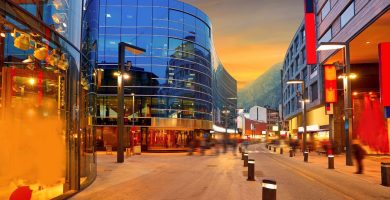
Andorra is much more than nature and sport. Its streets offer countless visual and cultural stimuli through the monuments, sculptures and buildings it houses. You will find all kinds of works of art and structures created by great architects and artists both from home and abroad. For this reason, here we indicate some of the monuments of Andorra and hemost significant and important places of interest in the country.
Many monuments, churches, chapels and villages have preserved their original character in Andorra. Romanesque art is omnipresent. Below you will find the most emblematic monuments that deserve a visit during your stay in Andorra.
15 monuments in Andorra that you cannot miss
In less than 500 square kilometers, there are twenty churches and magnificent monuments, without forgetting the places of contemporary architecture, more than 10 museums and exhibition spaces, to which we must add a dozen marked routes and itineraries, which allow us to discover the history of our country.
1. House of Vall
The Casa de la Vall is a building full of history. In the past, it was the main headquarters of the General Council of Andorra, the most important political meeting place in the country, which has witnessed great moments, such as the presidency of new positions or national emergency sessions. But that's not all, the presence and importance of this building goes back much further. It was created in 1580, and at that time the building served as a defense tower for the Busquets family. It was not until 1702 when it became public domain. Today, guided tours of about 30 minutes can be taken.

2. La Farga Rossell
It is located in La Massana and is the last of the Andorran museums. From the 17th to the 19th century, Andorra participated in the mining adventure, exploiting numerous iron deposits. But time has done its work and now there are few intact vestiges of that mining past. However, the Rossell Farga, built between 1842 and 1846, was miraculously spared attempts to demolish it or convert it into a sawmill or mill. Now restored, it has become an educational center that aims to explain the process of transforming mineral into ingots. The result is a trip to the past, thanks to a well-constructed exhibition faithfully supported by audiovisual and computer documents.

3. Espai Columba
The visit to the Espai Columba museum is combined with a visit to the church of Santa Coloma, located a few meters away, where you can marvel at the Romanesque architecture and the video mapping of the Romanesque frescoes in their original position. The six-minute projection allows you to see the creation of each fresco from the beginning. An authentic journey to the 12th century thanks to new technologies.
In this Andorran monument, a few meters from the Church of Santa Coloma, you can see how the murals were painted during the Romanesque period. Of the pieces exhibited in the museum, the Romanesque frescoes of the Church of Santa Coloma stand out, one of the most appreciated examples of this style in Andorra.
4. Cal Pal
Cal Pal is what we call a sawmill and is located next to the river in La Cortinada and represents a clear example of the active past of the Ordino valley. Cal Pal was built at the beginning of the 17th century, ceasing to operate in the 70s.
Through a guided tour we can visit Cal Pal and live the experience of how the wood was carved with the use of a hydraulic saw, where it is possible to appreciate each of the elements that make it up. The best experience that can be witnessed in Cal Pal is the transformation of wheat into flour. This exhibition is supported by explanatory audiovisual material.
5. Llorts Mine
In this wonderful Andorran monument, it is possible to discover how steel work was developed in the principality of Andorra in the 19th century, a time when this activity represented a good part of the country's income.
The Llorts Mine, however, only operated for 4 years as it had a small amount of extractable iron ore.
At present, the mine has public access only in summer, preserving a small exhibition gallery of about 30 meters in length.
6. Lime pal of the curtain
This peculiar home functions as a free access space, intended to publicize the origins, identity, and cultural and natural heritage of Andorra. The construction is a medium-sized house that was built in the 14th century, when it was the Escoter hostel.
It became the property of the Pal family during the late Middle Ages until the beginning of modern times.
7. Roureda of the marginalized
This majestic archaeological site is located on top of an almost imperceptible elevation of land, about 1000 meters above the sea, in the south of Montclar. This is, without a doubt, one of the main enclaves when it comes to Andorran history.
Its relevance is due to the fact that it is the only productive settlement in Andorra, but also in a large part of the Pyrenees, where a long and continuous occupational and productive activity has been maintained.
In short, a place to learn about the history of the principality of Andorra, the main materials exploited by its former occupants and its union with the Eastern Pyrenees.
8. Sant Miquel d'Engolasters
This well-known Romanesque church is in the Lombard style, and was built in the 12th century, and is made up of a small nave with a rectangular shape in its plan, a large bell tower and a semicircular apse.
This building is characterized by its simple architecture and the disproportion it has between its bell tower, about 18 meters high, and the base nave.
Inside, it is possible to see murals of Romanesque paintings that were given to the workshop of the Mestre of Santa Coloma.

9. Meritxell Sanctuary
The Meritxell Sanctuary is the most emblematic of the Principality, located between the parishes of Encamp and Canillo, and is known as one of the most recognized architectural works in the country. This monastery is the only one in Andorra that has been classified as a minor basilica, a title granted by Pope Francis in 2014. This recognition makes Meritxell part of the famous Marian route, where there are four other sanctuaries, which are Pilar, Montserrat, Torreciutat and Lourdes.
An anecdote is that in 1972, the original Meritxell sanctuary (located just behind the modern sanctuary) burned down. It was practically destroyed and unusable. Over the years it could have been rebuilt but it was decided to build a new, more impressive, larger and much more imposing place of worship. The person in charge of carrying out such an important task was the famous architect Ricardo Bofill. The result was the sanctuary that can be seen today, with its large courtyard and majestic arcades. The old sanctuary is still preserved and is currently used as a museum.

10. Sant Romà de les Bons
When passing through the center of Les Bons, in the Parish of Encamp, we will find a small church that was dedicated to San Román, which was consecrated in the year 1164, preserving the exact reproduction of the ancient Romanesque paintings of the well-known Master of Santa Coloma in the 12th century. However, we can still see some Romanesque murals that have thematic medallions that usually alternate bird motifs and plant motifs.
11. Santa Coloma
The church of Santa Coloma is a pre-Romanesque building from the 10th century, it has a Lombard bell tower that has a circular floor plan, which was added in the 12th century. Few Romanesque style churches have these characteristics in the principality. The construction was decorated with Romanesque murals from the same century, they were made by the Taller del Mestre de Santa Coloma, and were returned to Andorra in 2007, after an extensive period of time in the hands of foreign museums and collectors.
Inside there is a Baroque altarpiece from the 18th century and a Romanesque polychrome wooden carving of the Virgin of Remedies.

12. Sant Joan de caselles
A church located on a small hill visible from the road that connects Canillo with Pas de la Casa. This Lombard Romanesque style church is incredibly well preserved: the interior has maintained the original stucco decoration of the walls, with sculptures and paintings from the period except for the 16th century altarpiece dedicated to Saint John the Evangelist. It is worth highlighting the semicircular apse and the quadrangular bell tower.

13. Sant Climent de pal
Romanesque style church, Sant Climent de Pal is the most important and historic building in the small town of Pal.
The building retains the most notable features of 12th century architecture with some more recent additions. In fact, there are several interventions over time that have allowed the religious building to reach the present day almost perfectly. Particularly noticeable is the fact that, despite numerous renovations, the church is able to offer a clear view of the original structure.
Of national importance precisely because of its age, the church is considered one of the best examples of conservation among the most historic buildings in Andorra.
14. Sant Martí de la Cortinada
This Romanesque church, created in the 12th century, has undergone several transformations and extensions in the 17th century and later in the 18th century. Despite this, today, it still preserves a good part of its original painting murals.
For structural reasons, it was reoriented towards the north in the 16th century and the most recent altar has been decorated with polychrome wood as a dedication to the patron of the church in the 17th century. Among its most notable relics, it is possible to find wrought iron bars, in addition to furniture with the type of wood used in the 17th century, the original confessional and the carillon.

15. Canòlich Sanctuary
The Sanctuary of Canòlich located in the Parish of Sant Julià de Lòria was renovated in 1970 and its base was built on an old medieval building, which was curiously modified in the 17th century. This well-known sanctuary has undergone several transformations over time, the first occurring in the 19th century and then at the beginning of the 20th century.
For decades it has been the home of the patron saint of Sant Juliá de Lòria, who is known for being the Virgin of Canolich, and has a carved statue from the 12th century which is currently in the parish church of Sant Julià.